Sunday, January 3, 2016

Christmas in Florence

The Stoic One and I have been busy these past few weeks. First of all, we were part of a House Hunters International episode, featuring the apartment of our friends Joseph and Paul. It was great fun to be interviewed and see the process of how the show is made. When we lived in the US it was one of our favorite programs to watch. They said the program would be shown in 60 to 90 days, so I will let you know when we know. Joseph and Paul were very generous hosts and tried to include as many people and sights in the town as possible.

We had my sister and her daughter here for a few weeks and have been traveling around to sites near by. Gary's brother, wife, 2 boys and grandpa also made a European trip for Christmas so we had some time with them as well.

All of us decided to go to Florence for Christmas. We stayed at the Hotel Tornabuoni, one of our favorite hotels.


It is conveniently located across from the main Ferragamo shoe store. Red is definitely the color of the season, even in Flroence.


The hotel also has rooms with views of the Arno. Great people watching.


Because it was Christmas, I was unsure where we could eat, especially since there were 9 of us, but I found a great restaurant on top of the Westin Hotel, the Sesto on Arno.
http://www.sestoonarno.com

It was a fixed prixe menu, and very French. The service matched the views and the food was good.

Here are the "potato dumplings"aka gnocchi...

We all could have stopped after this dish, but we soldiered on...It was a once in a lifetime thing. Even for us, this was way too much food. Wouldn't do it again. Fun, though to have the family together and the views were fantastic.

Walking around Florence at Christmas is a joy. First there are scrumptious display windows that force you stop and admire the aristry.

Next, there are very few people on the streets. For those of you who visit Florence often, you know how rare this is.

Below is a picture of the duomo, the bell tower and part of the baptistery. It is the first time in ages that we have seen it without scaffolding. They have been working on cleaning the buildings and they have done a superb job. The marble glistens in the sun. A true delight to see. We have been told that they have spent tons of time and money cleaning the city for a visit from the pope next year.


I have always loved Florence at night. The Stoic One took some photos of the lights of Christmas. I hope you enjoy them.


We even had a full moon on Christmas night. The first one on Christmas since 1977. I am so very grateful for the life we are living. I hope each and every one of you have had a wonderful holiday and the best of new years.

Monday, December 7, 2015

Publishing a book in Italy

I expected to learn many things in my move to Italy, but one of them was not how to get a book published here. Before I came to Italy, I wrote a memoir about my spiritual journey, from working at Apple Computer, to going to seminary, to working at a women's federal prison, to being diagnosed with breast cancer, to finally transferring full time to Italy.

My Italian teacher loved the book, and wanted to translate it into Italian, which she did. She then shopped the book to publisher's here in Italy, and I am so please to say that we found a publisher, and the book is now available. The great thing about this book is that it is dual-language, Italian and English. The first section is in Italian and the second section is in English.  If you are trying to learn English, or Italian, this would be a nice book to have on your shelf.

You will see a link on my this page that directs you on how to order the book. There is also a companion guide that is free and available for down load, if you are interested in following your own spiritual path.

We had the presentation of the book at the Galleria Grefti here in Umbertide. We had a great turn- out and even the mayor showed up. FYI, that's me on the right and the mayor is on the left.


The evening was a little nerve wracking for me as I made a commitment to read part of the book in Italian. I managed to stumble through. The Italians are always so nice when you try, no matter how much you mangle their beautiful language.

Here is an intereview I did with the publisher about the book that gives some of the background of the content.


1. When did you decide to write this book?

I made the decision to write this book while I was still working as a chaplain at the Federal Correctional Institute in California.


2. What prompted you to write this book?

In the United States, most people do not want to think about the prison population, despite the popularity of the television program “Orange is the New Black.”  One of the female inmates asked me to promise that I would not forget her. She said that female inmates were the “forgotten of the forgotten.” By this she meant that while male prisoners are ostrasized by society, female prisoners are totally ignored by a world that denies their existence. This book is my effort to remind people that there are now 200,000 women incarcerated in the American Federal prison system, and each one of them has a story.

3. Looking back at your early religious experiences, do you believe that the deep faith you had as a child was a positive part of your life, or do you think it was a sign of your unhappiness?

I think it was both. Because I had an unhappy childhood, I had to look outside of my family for solace and comfort. As a child, I found this sense of love and acceptance in my relationship with God. I also believe that I was born with a gift of faith that allowed me to be open to the spiritual part of my personality. Overall, the faith that I had as a child, was a positive thing for me in coping with my circumstances.

4. In your book, you said that prior to beginning your training, you did not believe that the prison was a place you wanted to work. Instead, you thought that working with children in a hospital was your calling. How did working at the prison change your mind about this?

Before I worked at the prison, I had never known anyone who had gone to jail. I had never knowingly broken a federal law, and so I had no sense of identity with women who were incarcerated. I wanted to work with children in the hospital, because I had worked with and loved Marisa, and felt that I could identify with children in similar circumstances.
Once I started working in the prison, I began to see each woman separately with her own individual story, rather than just being a “woman in prison.”  Could I personally identify with the choices that the women made and the circumstances that they lived in? No. Their path was not my path. Their choices were not my choices. However, I came to understand that even though I personally could not identify with the events in their lives I could identify with their humanity. I could identify with their pain, their grief, their loneliness and their regret. I found that our emotional connection was stronger than our differences. My sense of our common humanity was stronger than a lack of identity with them, and so I was thankful that I had this opportunity to work with this population.


5. If you could go back in your work at the prison, is there anything about yourself that you would change?

I would change several things. First I would feel less intimidated by the power structure and organization of the prison system. The system is designed to intimidate the individual from the moment you enter the premise. The fence around the prison is not just for safety but to demonstrate an unbreachable authority. I wish I could have recognized earlier that the symbols were only symbols, and not believed in the power that they tried to exert over me.

In retrospect, I would  not be as anxious about doing the right thing. I would have more confidence in myself to be able to know how to be with the women in prison. I would be more clear with myself that the women had made choices that I, given my circumstances in life, would never have made. In certain ways, the women in prison were just like me, but in other fundamental ways, they were nothing like me. I would acknowledge this and acknowledge that I could still be helpful to them.

6. How did your life change after your experience at the Buddhist retreat center? Would you advise others to try this type of experience? Why?

The path of my life changed significantly after I attended the workshop on Death and Dying at the Buddhist retreat center. It not only was the beginning of my spiritual journey, but it also afforded me an opportunity to confront some religious biases that I still held that were no longer relevant in my life. The retreat also provided me a safe space to confront my own fear of death. For those people who are struggling with this basic human fear, I would recommend attending a Buddhist retreat such as I describe in the book.

7. In your book you describe visiting Italy when you were quite young. By having this experience at such an impressionable age, what influence do you think it had on you and your understanding of American society? Do you think that it limited you from totally integrating into American society because you had experienced this different world, or was it an advantage in some way?

Like many Americans, I have tended to idolize life in Italy. Italy represents, to many of us,  that which is lacking in American society; a strong, loving family, a slower pace of life, a more cooperative, rather than competitive environment and of course, excellent, fresh food. Change requires a vision of the future we desire, the ability to tell the truth about our current circumstances, and plans for the first step of change. Italy has been my vision of the ideal future. This vision has allowed me to get through many difficulties in my life, and I suppose in some ways, also kept me from feeling totally integrated into American society and culture.


8. Do you think your search for your five stones was a mystical journey or a psychological journey?
Let us first define these terms, spiritual and psychological. I think sometimes in modern discourse we equate the two in a way that is not helpful. To me, spiritual, comes from an understanding that there is a force in the universe larger than ourselves, while psychology is the work that helps us unravel our personal psyche. Beginning a spiritual quest, will often lead to psychological understanding. My search for the five stones was a search for life’s meaning in respect to my understanding of a force larger than myself, and so I see this part of my life journey as more of a mystical experience than a psychological experience. 

9. What was the criteria that you used to establish that faith, courage, kindness, service and love were your five stones?

Intuition was what guided me through this mystical journey. Where this intuition came from, I can not say for sure, but I believe that it was a force larger than myself that led me.


10. According to you, what was the symbolism of the stones? Why do you think that the hand of God showed you five stones and not other obects?

From a Biblical perspective, five is a number that is often used to separate the good from the bad; such as the parable of the 10 virgins, where five of them were foolish and five were wise. (Matthew 25:2) I think the story that is most applicable here is the story of David and Goliath. David took five smooth stones in preparation to kill the giant. (I Samuel 17) . What was it that Goliat represented? What was the large thing in my life that needed to be slayed? Perhaps it was this story that was in my unconscious when I had the dream about God telling me to find five, smooth stones.  

11. Do you think that there are other stones to search for or is five the perfect number? (If yes, what other number is there, if not why is 5 the perfect number?)

For some reason, I have always felt a special relationship with the number five. There are five letters in my first name, five letters in my middle name and five letters in my last name. For me, it felt complete to find the five stones, and discover their meaning for me. I believe that every spiritual search is individual but is always centered in the context of the greater good. It is important to remember to question what is the greater good for humanity especially given the terrorist attacks we have recently witnessed. If you believe that God is telling you to do something that is good for you and your religion but is against the common good of humanity, I think your idea has not originated from God.

Please feel free to email me through the web page if you would like to discuss any of these ideas.

The book is also available as an ebook, and you can order it through Amazon.


Monday, November 30, 2015

Thanksgiving in Italy

We have just celebrated our third Thanksgiving here in Italy. There are many ways that Thanksgiving is different here. Because it is not a national holiday, the whole meal just seems like a special time, with special friend and special food. There is no pressure or frenzy at the market. It is ever so much more relaxed. It is also fun to share this meal with Italians, who mainly have only seen the meal on TV. Thanksgiving in Italy is great, particularly if you have friends who bring cranberries over to you!

We chose to celebrate it on Saturday rather than Thursday so our Italian friends can come. This year there were 14 of us at the table. We all had a good time. It turns out the Italians love Thanksgiving. Who wouldn't really. Each year I think about asking people what they are most grateful for and each year it just seems too contrived, so I don't do it, so I thought I would do it here.

I am most thankful for my friends here in Italy and my friends who came to visit from the US. We are so lucky to live in a place that people love and want to come and visit.
I am grateful for Ely at Calagrana who prepares our turkey and antipasti for our dinner.

She has been a stalwart supporter and friend and I appreciate her immensely. For a Brit, she makes a very mean turkey as well.
The Stoic One looks a little stunned at the size of the turkey, even though it is a bit smaller than last year. The turkey was covered with pancetta and stuffed with citrus fruits. It was as delicious as you can imagine.

I am also very grateful for all of the men in our lives here. Joseph and Paul, Fabio, Simone, Luther, Jim, Gary, Manuele, Paolo.  Here are some of them trying to repair our Sonos speaker.

Although unsuccessful, we really appreciated the attempt!

I really appreciated Nancy, who brought the cranberry sauce, mashed potatoes and made the gravy once she got here. Oh yes, she also carved the turkey! She is wonder girl. I appreciate my dear friend Simona, who I hope to see more of this year, and Denise, who I also hope makes a choice in our favor so that we can see more of her too!

I appreciate all of you readers as well.  Tutti a tavola!


Sunday, November 22, 2015

Peace in Umbertide

There is a lot going on in our life right now. We have had many visitors for the past two months and have enjoyed travelling with all of them. I started a new beginner's English class with the nuns who live across the piazza. I am half way through a major work project for the US which is always fun. Next we are getting ready for Thanksgiving, which we will celebrate on Saturday, in order to include our working Italian friends, and will host 14 of us. Happily Ely, from Calagrana is doing the turkey again this year, as none of us has an oven that would accomodate an American style turkey roast. A lot on our plates, no pun intended.

In the local news, I am so very proud of Umbertide. Last night they had a special presentation in the church across the piazza. It was called "Pace KM0" or Peace at kilometre zero meaning bringing peace here. First the town asked foreign people to be videoed saying where they were born, their name and where they live. Gary and I of course participated. It was fantastic to see this short film of all of the different faces and places of people who live in this small town in Umbertide. http://www.perlapace.it/download/pacekm0.pdf

The poster says, Memory walks with us. There are 62 nationalities represented in Umbertide. It was amazing to see everyone. The theme of the evening was not to be afraid of foreigners, particularly in light of the Paris bombings. We were encouraged to get to know each other, welcome each other and speak to each other. They talked about the importance not just of liberty, justice, equality, but also of fraternity.

We walked over to the presentation to be supportive. We were asked to bring a dessert that represented our country so The Stoic One and I worked together (!) and made an apple crisp. I knew I had to leave early, because my English class was meeting in 45 minutes. Of course, nothing begins on time, and so I was late coming back home to class. The major thing was that the moderator asked me to speak in front of the group as to why we chose to come to Umbertide and how our experience had been here. Easy enough, except I had to ad lib in Italian. I apologized for my poor language skills but told them we had chosen Umbertide because of its beauty, accessibility and friendliness. All true. A very eventful day for all of us.

Wherever you are I hope that you are in a place of love of friends or family and are able to reflect upon all of the blessings of the season. Gary and I are so happy to be living our dream of life in this rambunctious, beautiful, and crazy country.

Tuesday, November 17, 2015

The Stoic One

I do still need him, but I might not feed him, but I will buy him wine to drink.
Happy 64th to the Stoic One. My beloved life companion.

One more year and he will be eligible to retire!


Tuesday, November 10, 2015

Lecce, Florence of the South


Lecce is a city that will seduce, beguile and ever so gently, educate you, but like all beautiful women, she requires your undivided attention. What makes Lecce so special? Why have the Stoic One and I made 4 trips here in the last 2 years? Let me begin my telling you a little story about the people. Several years ago Lecce was in competition for the 2019 European Cultural Capital award. http://europa.eu/rapid/press-release_IP-14-1176_en.htm

The city of Lecce lost to the city of Matera, also in the south and definitely worth seeing. (see my post on Matera...http://americansinumbria.blogspot.it/search?q=matera) The prize for this competition was 40 million Euros! Everyone I talked to in Lecce said that they were happy Matera won because that city needed the money more than Lecce. Matera has no railroad or airport, they said, and we have a very good train station and an airport close by in Brindisi, so it was good that Matera got the money. This was said without sarcasm, jealousy or resentment. Remarkable. In my experience, the people in Lecce are humble, kind and appreciative for what they have in life. They are also extremely welcoming to visitors and do all they can to make the tourist experience a good one. I wish more Americans would go to visit as they all love the US and welcome Americans with open arms.

The main thing that makes Lecce special and unique is the Baroque architecture. The period of high Baroque style was from 1625 to 1675. Historians believe that it was developed in response to the protestant reformation and was considered a primary component of the Catholic counter-reformation movement. Whereas the protestants threw out the madonna, the saints and all decoration both inside and outside of the church, the catholics went the other way and doubled down on adornments, florishes, and decorations. As you look at the facades of the building or inside the churches, is a panopoly of sculptures; fruit, angles, saints, trees, women, animals. The architecture is meant to inspire you with the power and artistry of the catholic church. Visiting Italy is nothing if not about the cultural experience and Lecce is a town that displays culture in an accessible way for most Americans.


Baroque is also defined by dynamism, or a sense of movement. Notice the carvings of these two women above a doorway at a palazzo in Lecce. Their garments are sculpted to show the movement of the wind as it blows through their dresses. 


Besides movement, Baroque is also about decoration. The three elements that are decorated in the Baroque style are the doorways, the windows and the balconies. Remember the goal of Baroque is to elicit an emotional respose in the viewer. If you have been awe-struck by the architecture of St. Peters, you have experienced the emotional theater of the Baroque style.


The Lecce stone, "pietra leccese" which is mined only in the enviorns of Lecce, makes Lecce unique in the world of Baroque architecture. It turns out that this stone is porous and soft when it first comes from the earth, which makes it ideal for sculpting, but then hardens, like cement after only a few years exposed to the atmosphere. This durability gives it the capacity to survive for 400 years. With time, it turns into a creamy yellow that makes the city look as if it is bathed in moonlight.


As a matter of fact, the city is particularly beautiful at night.


There are 56 churches in the historical center of Lecce. Each one can teach you something about the architecture of the era, the people and the way of life of a bygone time.

The next thing that makes Lecce great is the artisanship of its current population. Papier-mache, or cartapesta, is a true art form in Lecce. As the French say, "need is the mother of invention" cartapesta began as a craft about the same time as Baroque. It was used because the population did not have enough wood to make the statues that the church required, so they came up with the idea of using papermache. It is light to carry, easy to mold and paint and the components were readily available.  As you go into the churches and see the statues, take time and look carefully to see if you can tell that they are made of paper.


It is also important to comment on Lecce's long and complicated history. It was founded about 200 BC by the Messapi (a people whose origens are still debated.) It was conquered by Rome in the third century BC and there are remaining Roman amphitheater and theater that one can visit today. It was sacked in the Gothic Wars and remained part of the Eastern Roman Empire for 500 years.

This is the Roman Theater

The Roman Amphitheater in the middle of town.

There is much more, as you can imagine. The important thing is that with each invasion, and there were many, the people from Lecce absorbed the newcomers culture, sometimes food and sometimes language, which made them the interesting mix that you find today.

The food, wine and olive oil are also noteworthy. The bread and the sweets are fantastic, and fish is plentiful. The prices are low and the quality is high. What more can I say?

Lecce has not always been a great city for the tourists. Before the mid-nineties Lecce was riddled with crime, grafitti on the walls and a laissez-faire attitude toward the few tourists who straggled into town. That all changed when a woman, signora Andriana Polibortone became mayor in 1995. She saw that her city was going to die if changes were not made. She got the city cleaned up, repaired the streets, erased the graffitti and gave business owners 2 years of no taxes if they started a business aimed at tourists. She explained to the townspeople that tourism was their only economy, and they needed to take care of their treasures if they were to survive. The changes in the town, according to those who live there, have been remarkable. The town is very grateful to Sig. Polibortone, as you will be too as you walk around a clean, safe, beautiful city.

Both times we have stayed over night here we have stayed at a lovely B&B, Mantatelure'.  Marta provides excellent service, the breakfast is complete and the rooms and surrounding are beautifully designed.


As you can see, I am a big supporter of this city. I hope that American toursits will branch out and take a chance on Lecce. It is about a 5 hour train ride from Rome. Once in Lecce, you don't need a car. Just walking around the old town is enough to entertain and inform you of the history of this beautiful city.

While we were there we tour with an excellent guide, Silvia Mazzotta...I highly recommend her.


Recommendations:
Guide: Silvia Mazzotta : silvia_mazzotta@hotmail.com
Places to stay: Mantatelurehttp://www.mantatelure.it
Things to see: The Duomo Square, Bishop's Palace, Chiesa del Rosario, Church of Sant'Irene, Basilica of Santa Croce, Roman Theater, Roman Amphitheater. In May look for the Cortile Aperti...where privately owned palazzi are opened to the public for tours.
Places to shop: Jewellery, Tonda Designhttp://www.tondadesign.it Beautiful Italian made linens
society store lecce
Places to eat: Pesceria con Cottura (a fresh fish restaurant where you choose your fish and cooking style. Excellent.)

Wednesday, October 21, 2015

Puglia

After we left Monte Cassino, we drove down to Gallipoli, where we had rented an apartment for a week. The apartment was lovely with a huge terrace, that we were not able to use as much as we would have liked. Gallipoli is on the Ionian sea on the inside of the heel of the boot of Italy. It has a population of around 20,000 people and has a long and complicated history. There is a very strong Greek influence that remains in the city. We were in the old part of town.
This is the view outside our window.

Our roof terrace that we didn't get to use as much as we would have liked. Note the thunder clouds gathering.

The above photo was also taken from our terrace. Note the skull and cross bones beneath the cross. It is not a symbol of pirates, but of the death of Adam and the cross represents the resurection. At least that's one explanation.

On a clear day, the water was spectacular.

The above shot epitomizes why people love Puglia. Clear water, unpolluted air, and FISH!!


 The local fish market in Gallipoli.

From market to plate...

The colors in Puglia are very vibrant. They remind me of the colors in Mexico.

The colors of the windows are such a deep blue they almost look like the sky breaking through.


It was a little windy. The Stoic One has a hold of me thinking I might blow away.Note again that fantastic Puglian blue.


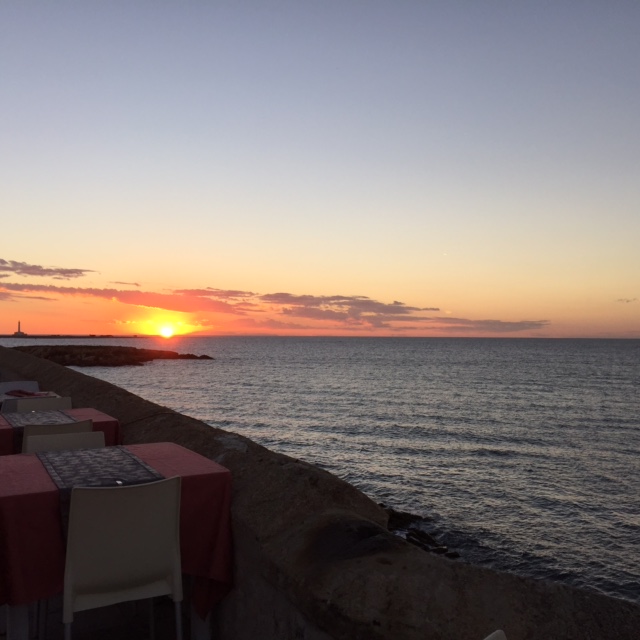
And at night, the perfect sunsets.